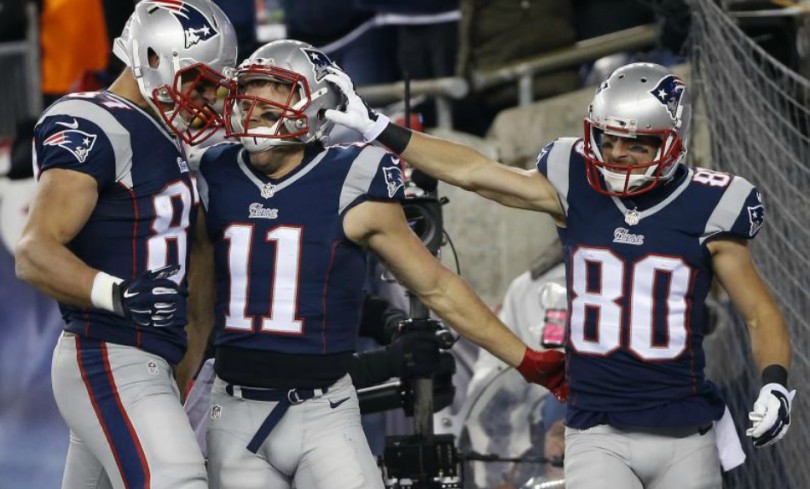
"For the milk drinkers, the thought is that Garoppolo will be used as more of a game manager, not unlike what Matt Cassell experienced initially in 2008 when Brady tore his ACL - only this time Brady will be coming back, so we may not see a true body of work from him. But the whiskey crowd wants to see the young fire-pisser jump in feet first from the very first possession, staking a claim as a legitimate professional quarterback.
The latter scenario seems to be the one gaining steam, as a decent performance by Garoppolo nets the coaching staff and Patriots' fans a little more solace in moving on from Brady in a few years - either that or it gives defacto General Manager Bill Belichick a solid gold trade chip moving into Jimmy's contract season - either way, Garoppolo is auditioning for something, which is a win in Belichick's book, and hopefully four wins on the scoreboard." - Foxborough Free Press, May 3, 2016
Think what you want about New England Patriots' quarterback Tom Brady's decision to give up on his last bastion of justice and accept a four game suspension imposed by the NFL for his alleged role in the so-called "Deflategate" saga - and there are many opinions - but there are just as many angles to consider...
...not the least of which that Brady's comfort level in leaving his offense in the hands of Jimmy Garoppolo, which has to be pretty high or that may have been a factor in accepting the suspension or not - or it could be precisely the opposite, where Brady chose to accept the suspension and serve the first four games so as not to potentially miss any important games down the stretch.
Either way, it doesn't matter. Garoppolo is turning in his clipboard for a green dot.
Garoppolo is set to become only the third quarterback to start a football game for the Patriots since Brady took over the offense early in the 2001 season, with Matt Cassel being the only other - a stat that promotes a rather amazing streak of endurance and consistency on the part of Brady. But as mentioned in the article cited above, this is a significant crossroads for Garoppolo.
This isn't just some hold-the-fort-until-Brady-returns job, the fate of at least one franchise is on the line, and probably a few more, as quarterback-hungry teams will be watching Garoppolo very closely.
The Patriots are at a crossroads as well, drafting North Carolina State quarterback Jacoby Brissett using third round draft capital, which is nothing to sneeze at considering New England had been stripped of a first round selection in this past April's NFL Draft, meaning that he is all but assured a spot on the Patriots'53 man roster - which presents an interesting scenario.
Should Garoppolo play up to his enormous potential, there are sure to be General Managers and head coaches around the league that would see him as worth giving up high draft capital to the Patriots to secure his services, probably dollars better spent than using said draft pick to take a top college prospect whose transition from college to the NFL is hardly a given.
Garoppolo is in his third season, is only 24 years old and has a skill set that enables him to be successful in just about any offensive philosophy.
Coming out of Eastern Illinois, Garoppolo was just a blip on the draft radar, most prognostication sites rating him as no better than a fifth-round pick - that is, until Garoppolo got to the post-season all star games, where he lit up opposing pass defenses with his compact, effortless-looking release and absolute rocket for an arm throwing into the intermediate zone.
"Garoppolo can find receivers and fire the ball on target faster than you can say his name. Lighting release and frozen rope medium distance sideline passes are reminiscent of Dan Marino's lasers. This despite concerns about his size, short arms and small hands." - Frank Cooney, NFLDraftScout.com
He shot up the big boards and was mentioned in the same breath as other top quarterbacks in the class, and came into the 2014 draft being pegged as the Texans' franchise signal caller with the first pick of the second round. Unfortunately for them, they passed on him at that point with the feeling that he would make it to the top of the third round, but Belichick pounced on him at the bottom of the second round, and Houston was forced to Plan B, Pitt's Tom Savage.
In retrospect, and even before Garoppolo takes the field on opening night, the move by the Dark Master was as shrewed as any Belichick has made in any draft, as he has either his franchise quarterback of the future under contract, or has a a stock certificate on the most prized commodity in football.
Maybe Belichick saw this coming in regard to the stupid and wrong Deflategate saga, or he really didn't want to have to rely on Ryan Mallet as his backup, or he simply just thought Garoppolo could be the successor to Brady - or maybe even a combination of all of the above - but whatever the motivation, Belichick is now in the same position with Garoppolo as he was with Drew Bledsoe after the 2001 season...
...trading Beldsoe to Buffalo for their 2003 first-round draft pick - and while Garoppolo isn't nearly as polished or experienced as the first overall pick in 1993, there is sure to be a general manager out there who would be willing to part with a second rounder, perhaps even a first rounder - and it wouldn't necessarily be during the next offseason.
Brady is due back from suspension in week 5, barely a month before the NFL trade deadline of November 3rd - a key occurrence as injuries could dictate a market for Garoppolo - or even Brissett - as it would be to the Patriots' advantage to shed a backup to Brady to create a roster spot somewhere else.
Of course, this is speculative. It could very well be that Belichick carries three quarterbacks as his team is absolutely loaded at just about every level, with no real or perceived needs. So with speculation being what it is - a guessing game full of hypotheticals and what-ifs - there is little doubt that all three signal callers on the camp roster possess a skill set friendly with the Erhardt-Perkins offense that Belichick prefers...
...but now that teams actually will have to game plan for Garoppolo - which means a concerted focus on taking away what he does best - how would a defense attack him?
As mentioned, Garoppolo's delivery is compact - a three-quarters delivery in which there is little-to-no windup - and when the ball leaves his hand, it comes out at just above his eye-level, and given that Garoppolo stands only 6' 3", the smart money is on teams understanding the Patriots' passing lanes and maintaining gap integrity.
It's not a sexy game plan and it lends itself to giving a little too much respect to a guy who has thrown less than three dozen passes in his career, but to blitz him is to bring his mobility into play and it also leaves one of his monstrous tight ends in single coverage up the seam - and to take him too lightly and play shell coverage, he has the ability to pick the secondary apart with quick hitters.
The math of all of this is that teams will have to play Garoppolo straight-up, and afford him a level of respect unheard of for a third-year clipboard holder - partially because of the freakish nightmare of pass catchers that he will have to throw to, but also because his technique in progression is so sound that he wastes very little motion, and the ball comes out hot with just the snap of his wrist.
"From his pocket mobility to his accuracy to his mental makeup, he has a lot of qualities you look for as someone you can develop at the next level. A lot of young quarterbacks leave their feet behind when they check to their next progression. But not Garoppolo. By keeping his feet tied to his eyes, he's always in position, ready to pull the trigger." - ESPN analyst Todd McShay
What McShay means by keeping is feet tied to his eyes is that Garoppolo's feet move in unison with his line of sight, and the way he holds the ball high on his pads, he's cocked and ready to fire at all times.
Where this is particularly effective is on the quick-rhythm routes conceptually designed to target both the Patriots' lightning-quick garden gnome receivers in the underneath zones and their aforementioned monstrous tight ends in the intermediate zone and deep up the seam - and even more so when Garoppolo is improvising outside the pocket...
As the audio mentions, Garoppolo's accuracy is pretty amazing, his footwork is extraordinary and he has a thick lower half that aids him in escaping the clutches of ill-intended defensive linemen and which also contributes to his accuracy - and all of this is on full display at about the fifty second mark of this video.
The laser that he throws for a touchdown after escaping the clutches of the Saints' pass rush should serve as a warning to defensive coordinators to preach pocket containment and gap integrity, because that ball got to wide receiver Chris Harper in a hurry, Garoppolo using his forward momentum and natural wrist-snap to put the ball right where it needed to be, right when it need to be there.
All of this being said, one would think that this could turn into another Bledsoe-Brady circumstance if Garoppolo lights the league on fire through four games, but all one has to do is to fast forward the video to the end sequence, a flat-footed overthrow that resulted in a long interception to understand that there will be no quarterback controversy...
...as Brady is a far more accomplished passer and is the greatest to ever play this game.
No, there are only two conclusions that will come out of Garoppolo's four-game audition - to be retained as the future of the franchise or be dealt to the highest bidder, and if Jimmy Clipboard ascends and plays light's out, then it will Belichick's task to determine which option is best for the team - both long term and short.
news, recaps and features focused on the new england patriots from my couch in lewiston, maine
Saturday, July 16, 2016
Tuesday, July 5, 2016
Reloading The Musket, Part 6 - Eclectic Patriots' Defense Much More Than The Sum Of It's Parts
![]() |
| Sheard (triple-teamed on right) and Brown (90) set the tone against the run and provide an effective pass rush |
The Top 100 players in the NFL have been revealed - all, that is, except for the top 10 - and unless one of New England's excellent linebackers are in that final group, no Patriots' defenders have been included on the list.
That really shouldn't surprise anyone, as the Patriots' defense has had more than it's share of detractors since the start of the current decade - six seasons featuring the now-familiar bend-but-don't break approach, where the defense gives up a ton of yards between the twenties, but not much more than that...
...ranking in the bottom-third of the league in yardage allowed, yet ranking in the top-third in points allowed. It's not sexy - in fact, it can be downright frustrating to watch at times - but it has been effective.
But for the past two seasons, the trend has been shifting from bend-but-don't-break to a more dominating approach. For example, in the 2014 Championship season, the Patriots' defense came in 13th in yardage allowed and eighth in points allowed, and followed that up last season by finishing in the top 10 in both categories - ninth in yardage and tenth in points allowed, only the second time in franchise history that the defense ranked better in yardage allowed than in points allowed.
That trend is certainly looking up for 2016, despite the fact that no Patriots' defender made the list of the 100 best football players in the league - a glaring omission that will likely add an additional twinge of motivation to a group of eleven that already had a chip on their collective shoulder.
But then again maybe not, as the unit is used to working in obscurity, taking a distant back seat to the potent offense led by future first-ballot Hall of Fame quarterback Tom Brady and his considerable weaponry - which is odd, since most of the top draft capital spent by head ball coach and defacto General Manager Bill Belichick recently resides on the defensive side of the ball.
2010 top round pick Devin McCourty leads a starting defensive lineup that sports no less than eight players drafted on the first or second day of the NFL Draft, with linebacker Dont'a Hightower and defensive tackle Malcom Brown joining the unit as first round selections in 2012 and 2015, respectively...
...while Brown's fellow defensive tackle Alan Branch was a second round selection of the Cardinals in 2007, with safety Pat Chung and freak linebacker Jamie Collins both Patriots' top picks as second round selections, Chung in 2009 and Collins in 2013. 2015 Free agent pickup steal Jabaal Sheard was a second rounder with Cleveland 2011 and cornerback Logan Ryan rounds out the list as a third rounder in 2013.
That's eight of New England's defensive starters that were selected with top draft capital as opposed to just three of the Patriots' offensive starters (Solder, 1st round in 2001; Vollmer, second round 2009 and Rob Gronkowski, second round 2010), so one would think from the disparity that New England would have twice as many players on the list from the defense as they do their offense.
Ah, but talk of such things such are for the split milk crowd, as is the collective anxiety generated when one thinks of the contract situation for the defense heading into the 2016 season.
Granted, the players most likely feel slighted, but those feeling are nothing that a new rich contract wouldn't cure, and the players who deserve to feel the most slighted - linebackers Hightower and Collins - are due for very big pay raises, indeed.
But first there is the matter of a football season, which for the aforementioned pair of linebackers is a contract year, along with such stalwarts as Sheard, fellow defensive end Rob Ninkovich and centerfielder Duron Harmon, and newbies playing on one-year deals in defensive tackle Terrance Knighton and rush end Chris Long.
That's a lot of talent hitting free agency after the season, but there are two things about the circumstance that should give Patriots' fans a little cleaner air to breathe: First, contract years usually equate to best efforts, and with that many auditioning for big contracts combined with a deep talent structure in place, we will likely see the best defense that Belichick has had in a decade or more...
...and secondly, as things stand now, the Patriots will have a whopping $63.5 million in cap space to play around with at the start of the league year in March, which could conceivably get everyone signed, and also get a new deal for up-and-coming cornerback Malcolm Butler as well.
So the focus going into the 2016 season should be all on the field of battle for a defense that should easily be one of the top units in the entire National Football League.
***********************************************
The New England Patriots are so eclectic in their players' individual skill sets that there is no way to properly hang a label on them.
Look on any football website and it will tell you that the Patriots run a 4-3, but the truth is that with as many hybrid players the defense possesses, they could easily slip into a 3-4 or morph into any number of exotic formations. That said, the reason for the Patriots' defensive successes last season was their ability to play primarily out of a 4-2-5 Big Nickle.
Those of you who follow my blog know from long experience that the Big Nickle is a defensive formation that follows the tenets of a traditional nickle defense - with four down linemen, two linebackers and five defensive backs - but with a twist: Instead of bringing in a third cornerback, the Patriots bring in a third safety, who drops into the box and acts as a weakside linebacker, providing coverage on running backs and heft in run support.
The Patriots are able to do this because they have a true centerfielder in Harmon, who is one of the best sideline to sideline blue liners in the game, and because they have the outstanding linebacker duo in Hightower and Collins. The Big Nickle is on them as the linebackers play the run, cover tight ends and rush the passer while Harmon patrols the deep end as the last line of defense...
...leaving McCourty to assist in coverages on wide receivers and supplement Pro Bowl corner Malcolm Butler and fourth-year man Ryan, while Chung drops down and becomes the primary playmaker. Add into that the pass rushing skill and edge-setting ability of Sheard and Ninkovich on the wings and the run stuffing prowess of Brown and Knighton on the interior, and the Patriots have a seriously stout defense.
There are not many teams who can set up the Big Nickle quite like Belichick has, as he stock-piles safeties that fit his prototype and, even more important, there are not many teams that can match up well offensively with the alignment, something that became more and more evident last season down the stretch, as the defense carried the handicapped offense.
How effective was the alignment? Well, for the entire season, the Patriots' defense allowed just three - THREE - 300 yard passing games, and held ten of their opponents to 250 passing yards or less - while on the ground they allowed less than 100 rushing yards in ten of their sixteen contests - but they saved their best performance for last, holding the eventual World Champion Denver Broncos to 244 total yards in an epic display of skill and strength.
That, unfortunately, wasn't enough as the offense constantly put the defense in poor field position and could only muster 18 points against what was the league's top-rated defense of 2015, and still could have won the game had any one of a number of poor decisions and poor executions had turned out differently.
But as Belichick is fond of saying, If "if's" and "but's" were candy and nuts, everyday would be Christmas - meaning excuses be damned. The Patriots came within a whisker of going to their seventh Super Bowl of the Belichick era, riding a defense down the stretch that was one of the best in the game.
There is no reason to believe that this year's edition can't expand upon that success, and in the remaining parts to this series, we will examine all three levels of the defense in detail, giving special credence to both the diversity of the talent and the resultant Big Nickle alignment...
Friday, July 1, 2016
Relaoding The Musket, Part 5 - Embarrassment Of Riches Adorn Patriots' Offensive Line. Really.
![]() |
| Mason (69) should have a roster spot all sewn up, but the same can not be said for Cannon (61) |
Think about it: On defense, they have what has to be the best safety depth in the league, a pair of linebackers that are sure to be in the top 30 of the NFL's 100 best players, and a defensive line that has too few spots for a plethora of outstanding run-stuffers, edge setters and pass rushers...
...while on offense they have the greatest quarterback who ever lived, backed up by the most game-ready sophomore in the league, a set of tight ends that are so good that they dictate what receivers are kept on the roster to complement them (not to mention , and a collection of running backs that fit the philosophy perfectly - and an offensive line absolutely stocked to the brim with talent.
That is a far cry from what we witnessed during the second half of last season, and that we heard from the media and other casual fans, but last season was an aberration in that injury - to the line and to many skill position players - dictated what the line was: a collection of matadors who simply stepped aside and let quarterback Tom Brady deal with the onslaught of pass rushers.
Which is bullshit, of course, but fans can be excused for seeking a scapegoat after the huge egg the Patriots' offense laid in the final two months of last season, misguided as it is.
Because it's not like the Patriots' offensive linemen suddenly sucked after years of stout protection - and truth be told, they really weren't that bad, given the circumstances. There is no hiding the fact that the struggles of the offense were directly attributed to the struggles along the line, but the aforementioned circumstances put the injury-decimated line in the no-win position of being no more than a levee attempting to hold back a tsunami.
Six playoff teams gave up more sacks and quarterback hits than New England's offensive line did in the regular season, including two conference championship game participants and the eventual Super Bowl champions - and in the post season, all three of the Patriots' fellow conference championship participants gave up more sacks, but none of them allowed their quarterback to be hit more than Brady was.
Perhaps that was because no one threw the ball more than Brady, as he dropped back an insane 49 times per game in the playoffs, a full 19 more than both Super Bowl participants. When put in that context, the Patriots offensive line was actually the best team at protecting their quarterback.
Where they fell short is in the running game, running the ball just 31 times in their two playoff games while calling 98 passing plays, a balance disparity of 76% to 24% in favor of the passing game - and if one were to eliminate Brady's rushing attempts, they would discover that the running backs to handoffs from Brady just 22 times.
Arizona was in the same boat, so to speak, losing in the NFC Championship to Carolina and abandoning their running game when they fell behind by 17 points in the first quarter while Carolina enjoyed balance on a epic scale, and the Broncos were almost perfectly balanced in their narrow win over New England, who simply had run out of players for Brady to hand off to.
What does this have to do with the offensive line?
When the Patriots lost LeGarrette Blount to a season-ending hip injury in week 14 against Houston, they lost much more than just a player - they lost the ability to create balance, and when a team becomes one-dimensional in the manner that New England did, it affects the offensive line more than any other unit on the offense.
Think about it. When a team doesn't have a very good passing game and are forced to run the football, the defense can load up the box against the run and leave their corners one-on-one with the receivers, rendering the running game inert. By contrast, if a team doesn't have a running game to speak of and are forced to the air, the defense can pin their ears back and come after the quarterback, overwhelming the offensive line with sheer numbers.
That is exactly what happened to the Patriots' offensive line last season.
Their troubles began in the preseason when starting center Bryan Stork suffered a concussion which eventually landed him on the team's injured reserve list, with a designation to return, leaving the job to Ryan Wendell - but when undrafted rookie David Andrews beat out Wendell for the job, New England found themselves starting the season with all three interior line positions manned with rookies.
Career backup Josh Kline was added to the mix, spelling left guard Shaq Mason and right guard Tre Jackson and for the first three games, things seemed to be on the up-and-up for New England, as Andrews was drawing raves for his technique, Mason for his athleticism and Jackson for his sheer size and toughness - and when combined with veteran bookends in identically-sized tackles Nate Solder and Sebastian Vollmer, the Patriots looked to have one of the more intriguing young lines in the NFL...
...but that all changed in a week 5 matchup with the Cowboys in Dallas, as New England lost blindside mauler Solder and his backup, young LaAdrian Waddle, in consecutive series - Waddle suffered a shoulder injury and would return in a few weeks, but Solder was shelved for the season with a torn bicep.
Vollmer moved from the strong side to take over on the left and swing tackle Marcus Cannon filled in on the right, but the following week in Indianapolis started a turnstile of revolving linemen - Cannon started at left tackle against the Colts and Vollmer went back to his accustomed right tackle, but Cannon lasted only one quarter, forcing the Patriots to bring in their third line grinder in Cam Fleming...
And so it went, as New England ended up starting 13 different offensive line combinations and never finding that cohesive bond due to minor injuries among the interior linemen, Solder's injury and Stork's absence until he could come off the IR in November.
The issue, of course, was with the swing tackle depth, as neither Cannon nor Fleming were consistently effective. In fact, things got so bad that upon Stork's return, the team started him at right tackle against the Giants in Week 10, rather than go with what they knew wasn't going to work against New York's elite pass rush.
Now, according to my math, New England did exactly nothing to rectify the issue with tackle depth, leaving the team's fate in the hands of Cannon, Fleming and Waddle - but while that will cause shivers down every Patriots' fan's spine, it has to be remembered that all of them suffered from the imbalance in the play calling which by the time the season ended was being dictated solely by however many pseudo-healthy bodies they could put on the field.
Waddle has untapped potential as a blindside protector, having played on the left at pass happy Texas Tech, and holding his own against the best the Big 12 had to offer as far as pass rushers are concerned, including future All Pro Von Miller - the same Von Miller who shamelessly abused Cannon and Fleming in the AFC Title game and who did the same to Carolina in the Super Bowl to garner MVP honors.
But that doesn't mean there isn't hope for the edges in the event of injury, as the aforementioned elite tight end tandem of Rob Gronkowski and former Chicago Bear Martellus Bennett will rarely - if ever - come off the field because of their skill not only as pass catchers, but also as devastating run blockers.
Gronkowski has always been a factor in the running game, but so was Michael Hoomanawanui, who was dealt to New Orleans at the end of September, upgrading the Saints' edge blocking by a significant margin while leaving New England with a gimpy Williams and little else opposite Gronkowski.
In return, New England shored up the interior of their defensive line with three-tech Akiem Hicks and, in truth, he was a main cog that allowed the Patriots' defense to carry the team through the difficult last two months - but maybe they wouldn't have had to rely on the defense as much had they kept Hoomanawanui...
...but that is a double-edged sword, and pointless to even argue, especially since the position is now well-stocked with H-back types and monstrously complete tight ends, so the tackle depth isn't as critical since there are so many folks able and willing to lend a hand if the onus falls to one of the depth options already on the roster.
One of those options was thought to be third-round pick North Carolina State rookie Joe Thuney, but on second glance Thuney is sort of an enigma. He has the length to play on the outside, but has short arms and panics a bit with speed rushers and has a tendency to latch on if he thinks he's going to be beaten on the corner, and tends to lean on them if they try inside technique.
So, many are expecting Thuney to compete for a spot on the interior, where he can slide-step to mirror three techs and his short arms and tendency to lean won't cause as much of a balance issue. In that respect, Thuney is a project, but with upside and a great teacher in line coach Dante Scarnecchia, he should be a depth fixture all over the line, particularly on the inside
Besides, on the inside is where the embarrassment of riches lie as well as the resultant too much of a good thing.
Andrews proved that he could handle the pivot while Stork recovered on the IR, and offered a technically sound pass anchor, though he is undersized with a light lower body. He doesn't offer and position flexibility, however, which limits his roster potential as Stork and newcomers Jonathan Cooper and Joe Thuney all excel at multiple positions, including center.
Of course, Stork's health is a concern, so the center position is volatile spot. If Stork can stay healthy, he's the best option at the pivot, but will head ball coach Bill Belichick keep a pure center on the roster to back up Stork, or will Andrews find himself on the waiver wire come September? One thing is for sure, with his body of work as a rookie, he won't clear waivers.
Both guard spots are wide open for camp competition, and Belichick has to hope that newcomer Jonathan Cooper rises above his incumbents and realizes his enormous potential.
Drafted seventh overall by the Arizona Cardinals in 2013, the oft-injured Cooper came into the league lauded as an excellent pass blocker and works better from the left guard spot, which enables him to use his elite foot quickness and outstanding power to pull to the strong side and to stonewall bull rushing tackles...
...which is primarily what incumbent left guard Shaq Mason excels at as the class of 2015's best drive blocker, edging out the huge right guard Tre Jackson for that title. Both struggled as rookies in pass protection, however, which lends credence to Belichick's insistence that Cooper be part of the compensation package in the deal that sent defensive end Chandler Jones to Arizona.
Kline is serviceable, if undersized, as a rotational guard, but his time in New England may be about to expire as Cooper, Mason and Jackson are the top three guards on the roster and Thuney is a virtual roster lock as a third-round draft pick.
Traditionally, Belichick has kept ten offensive linemen on his 53-man roster, and when you consider those four, plus four tackles and two centers, it leave nothing but the waiver wire for everyone else - that is, unless sixth-round pick Ted Karras puts his impressive lineage on display and steals one of the guard spots....
...but Karras seems destined for the practice squad, while Kline, either Marcus Cannon or Cam Fleming, Chris Barker and Keavon Milton attempt to latch on elsewhere.
That's what happens when you have too much of a good thing...
Saturday, June 18, 2016
Reloading The Musket, Part 4 - Lewis To Be Featured Back In Patriots' Juggernaut
"...Blount has plenty left in his 30 year old legs, but not so much that the team won't select a running back in the draft, one with some power and with some explosiveness, because truth be told, Blount has all of the explosiveness of maple syrup.
He is, however, a good complementary back when passing backs Dion Lewis and James White are mixed into the equation. White wasn't productive between the tackles, but was pure smooth hell in the pattern and put forth a yeoman's effort in picking up the blitz, while Lewis is everything a running back should be, and then some." - Foxborough Free Press, April 14, 2016
New England Patriots' general manager Bill Belichick is not an easy man to pin down, as anyone who has tried to figure out his draft board has experienced.
The general sentiment going into the 2016 NFL draft is that the Patriots were in need of a blue chip bell-cow running back that would put the team on his back, make yardage on his own behind what was wrongly perceived to be a terrible offensive line and bring new life to a running attack that ranked in the bottom three in all of professional football.
So what did Belichick do? Almost completely ignoring the position in free agency and selecting a grand total of zero running backs in the draft, the Dark Master once again stunned the experts and confounded the fan base with his complete disinterest in what anyone else thought his team needed, and instead went about his dark business with a heart full of hate...
...signing a brace of former first-round draft picks in free agency to make up for the top draft capital taken from him by the league in their over-reaching response to a still-alleged ball deflation scheme, and then using the draft picks he had left to punk the experts by going heavily defensive, while tip-toeing around the perceived needs on offense.
My own mock drafts were an exercise in why-the-hell-do-I-even-bother, mocking the Patriots to move up for Derrick Henry or staying put in the second round for Jordan Howard or waiting even deeper into the draft - which I was certain was the safest route - to select small school back Darius Jackson, only to be denied in my belief that the Patriots needed that large, bell-cow running back to continue their offseason trend of becoming more physical at the point of attack.
But what we all found out instead is that Belichick is content with what he already has, and that we should have known this all along - and he's right, as usual, because he has a diverse range of skill sets lining the depth chart that, if he can get offensive coordinator Josh McDaniels to use them correctly, will be very difficult for an opposing defense to deal with.
Of course, most of that has to do with the immense amount of talent among the tight ends, where defenses will be forced to focus, opening up running lanes and wheel routes for the backs - and in that respect, Dion Lewis should be considered the New England Patriots' featured back.
Hell, the way their offense is structured, he may even be a bell-cow - but not in a traditional sense, for the demure Lewis stands only 5' 8" tall and doesn't even tip the scales past 200 - not to mention his durability concerns will likely limit him to just the featured role, but he is built to carry the load, and then some.
Preposterous, you say?
Lewis has had some injury issues since entering the league as a fifth round selection of the Philadelphia Eagles in 2011, and even had some shoulder concerns in his last season at the University of Pittsburgh, but still "shouldered" the load in his freshman and sophomore seasons before declaring for the NFL draft, because he had very little left to prove at that level...
...not after rushing for 1800 yards and 17 touchdowns as a freshman to win the Big East Conference's Rookie of the Year and Offensive Player of the Year - something done previously only by Virginia Tech's Michael Vick a decade earlier - his two year total of 2860 yards eclipsing LeSean McCoy's team record for rushing yardage in his first two seasons.
What's more, the man Patriots' receiver Julian Edelman nicknamed "Little Dirty" broke the freshman rushing record at Pitt, held previously by some dude named Tony Dorsett, and was named MVP of the 2009 Mieneke Car Care Bowl, named National Freshman of the Year by CBSSports and Sporting News, was a consensus second-team All American, with Sporting News even going so far as to claim that Lewis was "the game's most complete runner."
So with nowhere to go but down after such an auspicious start to his college career, Lewis followed Shady's lead in leaving school after his sophomore season, but quickly found out that as far as running backs go, size does matter, and if you don't have size, you'd better have something special that will make scouts and coaches not care about that so much.
So despite all of the records and accolades in college, Lewis ended up playing behind McCoy in Philadelphia, barely seeing the field, as McCoy was just starting to blossom as a superstar and received over three quarters of the offensive snaps - but on the occasions that lewis did get into games, he impressed Eagles President Joe Banner to the point that when Banner moved on to Cleveland, he worked up a trade to get Lewis on the Browns.
The plan was - according to then-Browns' offensive coordinator Norv Turner - that Lewis was brought in to be the starter over Trent Richardson, but he suffered a fractured fibula in the Browns' second 2013 preseason game, and was lost for the season.
"I would say he was going to play a great deal had he not been injured," Turner said in an interview last year, "After Richardson (was traded), Dion would have definitely been the starter."
So, Lewis is a featured back. He was tabbed as the starter in Cleveland and he literally ripped that role away from Patriots' incumbent LeGarrette Blount to start 2015, and was on pace for 700 rushing yards and an absurd 1000 receiving yards, both numbers uncharted NFL territory for Lewis but for different reasons.
Before signing with New England, Lewis had caught just three balls for 21 yards for his pro career, after logging only 52 in his college career, prompting several draft scouts to question his fit as a passing back on the next level, the ambiguity concerning his receiving skills part of the reason why he slid to fifth round.
But the biggest knock against Lewis was his size, those same scouts universal in their notion that Lewis could not be an effective inside runner in the pros despite record-setting success in college, yet Belichick and offensive coordinator Josh McDaniels sent him up the gut thrice as often as on the edges for an impressive 4.9 yards per carry.
Now, this is not to say that Blount was discounted in any manner by the Patriots, as while he was used sparingly early in the season - he had just 25% of the offensive snaps through the first half of the season compared to Lewis' 63% - he was an effective runner in his limited opportunities, and was actually on pace for a 1000 yard season before his hip attacked him with four games remaining.
Blount is pure power, his 6' 0", 250 pound frame gaining separation from would-be tacklers by simply running them over, and sometimes with the aid of a nasty stiff-arm, while Lewis has the innate ability to slip tackles in the hole by getting tacklers leaning one way, then side-stepping them or making them whiff with a disturbing spin move.
Both have their place in Belichick's version of the Erhardt-Perkins offense, it's motto being "Pass to score, run to win."
If looked at in that context, where the offense uses the passing game to gain a lead and then turns to the running game to wear down both the clock and the defense's will, then the Patriots offense is well on their way to being as fundamentally sound as any philosophy in football, and similarly dangerous - because let's face it, Lewis is the most explosive player on the team.
Passing back James White offers a competent alternative and change of pace from Lewis, to spell him at times on obvious passing downs. While not as elusive as Lewis - and, really, how many players around the league are? - White has more size and is more versed in pass protection, willingly putting his body between blitzers and Brady.
What White doesn't offer is much in the running game, so obvious passing downs is the only time we will see him, and even then it will be sporadic. That said, White has a trust bond with Brady after ably filling in after Lewis went down last season, and put together quite the compilation package to state his case.
Free agent pick up Donald Brown is a head-scratcher, unless Belichick feels that he offers something in the running game - which he might. Brown's salad days were with the Colts, offering a change of pace to backs like Joseph Addai and Trent Richardson and averaging a serviceable 4.3 yards per carry, but spent plenty of time in the trainer's room and on the injury list.
Not surprisingly, Brown's best seasons were in 2011 and 2013, the only seasons that he played in all sixteen games, averaging 4.8 and 5.3 yards per carry, respectively - but that average dipped substantially when he left Indianapolis for San Diego, with whom he signed a three year deal then watched his effectiveness dip to 3.2 yards per carry.
Brown will have to show plenty in training camp to make the team, but the fact that he does many of the little things very well gives him a fighting chance.
Joey Iosefa and Tyler Gaffney round out the camp look for New England, and also Arizona rookie D.J. Foster, though the team lists him as a wide receiver. Iosefa became a bit of a cult hero for a time last season for trucking Titan's cornerback Cody Sensebaugh, then was inexplicably released a week later despite the team having just White and special teams ace Brandon Bolden as runners...
...but Belichick told the University of Hawaii alum to stick around and that he would be resigned to the practice squad - which pretty much sums up what happened to Gaffney this offseason.
The Stanford grad is a bruising interior runner who as a senior ruined run defenses in the Pac-12 to the tune of 5.7 yards per carry and over 1700 yards, topped off with a ridiculous 21 rushing touchdowns. Despite the lofty numbers and his performance at the combine, Gaffney fell precipitously in the draft, finally selected by Carolina in the sixth round.
Many in the league felt that Gaffney favored baseball, for which he left Stanford for a year after being drafted by the Pittsburgh Pirates, which is the biggest reason why he lasted so long in the draft, while other drawbacks seem to stem from his lack of wiggle, with virtually no elusiveness to his game - just a straight-ahead, no-nonsense power runner who isn't afraid to mix it up.
Unfortunately for Gaffney, he has hit the IR in both of his years in the league, without ever appearing in even a preseason game, which makes assessing his value to the team difficult, but Belichick wouldn't have kept him around unless he had some idea of what the kid brings to the table - even if he did cut him earlier this spring, only to resign him at a better cap number.
If Gaffney makes the roster, one of the aforementioned will probably have to go, but that unfortunate player is not Dion Lewis...
...because Dion Lewis is the featured back.
Wednesday, June 15, 2016
Reloading The Musket, Part 3 - How Many Receivers Do The Patriots Need Anyway?
"The way the Patriots' offense looks to be structured will have an impact not just on the fringe depth at tight end, but probably will impact the receiving corps and depth at offensive tackle...as Bennett will take a roster spot from at least one of the swing tackles and from one of the wide outs, as his blocking ability on the edge combined with his pass catching prowess gives Belichick some roster flexibility, and given the fact that he will rarely come off the field." - Foxborough Free Press, June 7, 2016
A syllogism is a form of reasoning in which a conclusion is drawn from two assumed or given premises, each of which shares a term with the conclusion and shares a common middle term not present in the conclusion - an example of which would be something to the effect of, "If it rains, we will not have a picnic. If we don't have a picnic, we will eat at a restaurant. Therefore, if it rains, we will eat at a restaurant."
This tenet of deductive reasoning allows us to assume things in a manner that doesn't make an "ass" out of "u" and "me", which is important for folks like mathematicians, scientists and, apparently, football prognosticators and beat writers - well, maybe not beat writers, but people who really care about accuracy and accountability.
It doesn't always work out, because syllogism doesn't rely on validation or truthfullness or even factoids, rather,it afford free reign to imagine and to dream, if one is so inclined - the only rules being one term influencing another to arrive at a logical statement or conclusion.

What does this have to do with football? It is deductive reasoning that allows coaches to track trends to incorporate into game planning, so they know that when they see a certain formation with certain personnel, they can conclude that, more likely than not, a certain play is coming.
The same dedustive reasoning is present in the team building process as well. Let's take the New England Patriots as the offseason's prime example, and their acquisition of tight end Martellus Bennett in particular:
Martellus Bennett is a complete tight end
Complete tight ends rarely come off the field
Therefore, Martellus Bennett will rarely come off the field
And why should he? As we know from the second part of this series, the addition of tight end Martellus Bennett changed the dynamic of the offense, affecting almost every position on the squad - he is a strong blocker on the edge in the running game and possesses a skill set that will likely make him no worse than a number four receiver, more than likely a number three.
All that means is that it will be a rare occasion indeed if either he or his All World compatriot Rob Gronkowski ever come off the field, and the same can be said for top wide out Julian Edelman. That leaves two "skill position" spots up for grabs in a so-called starting capacity, and at least one of those will be going to be a running back, either power back LeGarrette Blount or passing back Dion Lewis or, in his stead, James White.
For the offensive line, it impacts the tackle depth, as with Bennett and Gronskowski playing on the edges, it eliminates the need for at least one swing tackle, a roster spot that can be used elsewhere, and not necessarily on offense - or maybe so as New England will be forced to keep three quarterbacks, as opposed to two from last season, which takes up that extra spot.
But enough about the line and quarterbacks for now, as we'll cover them in later pieces - right now the question begs, just how many pass catchers does Tom Brady need - or an even better question is how many roster spots will be open for his wide receivers, because the tight end and running back depth is pretty much assured.
Just for comparsions sake and in an attempt to establish somewhat of a base line, in 2015 Belichick kept four tight ends, five running backs and five receivers, not counting Brandon LaFell, who started the season on the PUP. In part, these numbers were dictated by a rash of injuries before the preseason ended, but the sylloism begs:
In 2015 Belichick kept just five receivers
Injuries reduced the receiving corps to pedestrians
Therefore, Belichick will keep more receivers in 2016.
That isn't necessarrily true, but still counts as a syllogism because they are limited only by imagination.
Besides LaFell being on the Physically unable to perform list to start the season, the preseason claimed fellow receivers Brandon Gibson and Brian Tyms, H-back James Develin and center Bryan Stork, who was designated to return and did so in week nine - and all of this after Belichick released Kenbrell Thompkins and the disappointing Josh Boyce.
A constant revolving door of player movement ensued, with names like Jonathan Krause, Jalen Saunders and even the venerable Reggie Wayne being signed and then released, eventually leaving the Patriots with Julian Edelman, a clearly hobbled Danny Amendola, a timid Aaron Dobson and rookie Chris Harper and wide receiver in name only, Matthew Slater, a process that limited the passing game to literally, just one Edelman injury away from disaster...
...which eventually happened and, coupled with a myriad of injuries on every level of the offense, doomed the Patriots to finish with a putrid 2-4 record down the stretch. then squeaking out a divisional round playoff win over the Kansas City Chiefs before succumbing to the eventual Super Bowl winning Denver Broncos in the AFC Title game.
Clearly, the wide receiver position is one Belichick would like to take a mulligan on, as well as on free agent tight end Scott Chandler, who underwhelmed before being injured halfway through the season and failing to give Belichick an updated version of the two-tight end offense that he's been so fond of.
Ok, so that's two mulligans, which will generate rude grumblings on the golf course and did cause grumblings of discontent among Patriots' fans, though most simply blamed the offensive line for the fiasco, but the truth of the matter is that General Manager Bill Belichick took a chance and hoped that the injury bug wouldn't treat him too badly...
...but it instead kicked him square in the teeth, and it would have been even worse than it was had he not saved a measure of ego with the performances of his passing backs, as first human joystick Dion Lewis and, eventually, James White doing yoeman's work out of the backfield, with White taking over for the injured Lewis and joining with Gronkowski to give quarterback Tom Brady his only reliable targets down the stretch.
Even then, there was a sliver of hope that New England could ride their excellent defense and score just enough points to make a deep run in the playoffs - that is until power back LeGarrette Blount injured his hip and was also gone for the season.
The fact that the Patriots came within two points of going to the Super Bowl anyway is either a testament to fine coaching or plain stupid luck - or a combination of both - but that's a ride that Belichick doesn't want to take again this season, nor ever again.
The four tight ends kept was pared down to three when Belichick dealt Michael Hoomanawanui to New Orleans at the end of September, which will probably be the number that the Patriots keep on their 53 man roster - while in the backfield, he kept five backs initially before unloading soft-blocking Travaris Cadet a day before dealing Hoomanawanui.
Both of these units impact the receiving corps in a way that not many other teams can claim, in that they are loaded down with top-end talent at tight end and have a trio of fine young greyhounds in the backfield who can -and will - be deployed outside the numbers from time to time - and if the number of legitimate pass catchers kept on the 53 man roster is any sort of tamplate to follow coming into 2016, then the most intense roster battles are going to be at wide receiver...
...with no less than seven players vying for one spot, two at the most - because Belichick has amended his normal thought process in regard to philosophy with the addition of Bennett.
As we've already read, There is so much versatility and overall talent on this roster that Belichick can't look at his positional groupings in terms of set numbers, rather, his task is to identify the players that give him both positional versatility and the best chance at forcing the opposing defense to defend the entire field - because if you can't do that, things like what happened the final couple of months of last season occur.
Currently, there are 22 eligible pass catchers on the Patriots' roster, and if one were to eliminate the locks - Gronkowski, Bennett and Harbor at tight end, Blount, Lewis, White and Bolden at running back, plus figuring in Edelman, Amendola, Hogan and Matt Slater at wide receiver - there are eleven roster spots taken right off the top, leaving three, possibly four, spots up for grabs.
Legitimately, one could go to fullback James Develin, another to running back Donald Brown and wide receiver Malcolm Mitchell appears to be a sure thing as a fourth round draft pick, meaning that there is maybe one spot up for grabs between at rest of the pack because the team will carry nine offensive linemen - at minimum - and there are three quarterbacks that need to be accounted for.
Of course, this is all just specualtion, but isn't the entire point of balance on offense to make the opposition defend the entire field, not allowing them to load up on one aspect or another?
Because that's the key, folks, the most fundamental concept in football since the advent of the forward pass brought the term "balance" to the gridiron - but balance in the way the Patriots think about it is more about personnel usage than simply run versus pass - though a solid balance between the run and pass is essential.
For example, we are virtually assured of seeing at least two tight ends and one running back in on every play from scrimmage - which is the "12" personnel package - because the dynamism inherent on the depth chart dictates that the tight ends and running backs are going to account for well over half of the receptions made by pass catchers.
...which was the case in 2015 (53%), because by the time all of the injuries took their toll, all that was really left to catch footballs from Brady was White and Gronkowski, with Amendola the lone wide out that made any impact.
Lewis was well on his way to a 70 catch season, as was White after replacing Lewis, and assuming that Gronkowski and Bennett are good for 70 catches as well - that's 210 receptions for the top non-receivers, and with Brady averaging right around 400 completions per season , the numbers allow for minimal contributions from the wide receiver corps.
That's how the offense is designed going into 2016, but most fans - and even the beat writers - also know that Edelman is going to have his share of targets, as will Amendola and the newcomer Hogan, but after that will be meager scrapings, so for Belichick to get the most bang for his buck, 12 and 22 personnel groupings will be the standard...
...meaning that only two receivers will see the field in most packages, and just one if New England decides to go heavy, which should happen mostly on third downs and in the red zone. Even if they go five-wide, they have shown in recent history that a running back will always be a part of that equation, and most times Gronkowski is involved.
Because, well, think about it - if you were offensive coordinator, would you take Gronkowski, Bennett, Edelman or Lewis off the field? Ever?
Not Josh McDaniels and certainly not Bill Belichick, who thought enough of himself and the franchise to thumb his nose at the powers that be who saw fit to take away his prized top draft capital by going out and grabbing Bennett for next to nothing, knowing that he was adding him to what was already a roster loaded with playmakers
So, how many wide receivers do the Patriots need? Well, therein lies a pretty significant problem of having so many playmakers in the passing game at other positions that the receiving corps has been relegated to being borderline complementary to the tight ends and backs in the pattern - so there will be plenty of meat for other teams to pick off the waiver wires from the Patriots...
...as names like Nate Washington, Aaron Dobson, Keshawn Martin, Chris Harper and DeAndre Carter may very well become available for other teams to snatch up - which would be a shame, particularly for Martin, who just signed a two-year extension, but he did receive a $600,000 signing bonus with the deal, meaning that the Patriots likely see him on the roster as well.
And that's it. There's just no more room at a position that has been largely dictated to by roster and philosophy. The tight ends and backs are just more important in the grand scheme, because they are far more versatile than being just plain pass catchers - and the same thing is going to happen to the offensive line, but that's for a later piece.
Ah, Bill, leave it to you to take perhaps the NFL's most proficient and deadly passing attack and transform it into something that discounts tradition. They will stretch the matter by adding Matt Slater to the mix as a special teamer, but it looks like any player not named Edelman, Amendola, Hogan or Mitchell may be seeking new digs come September.
If the Patriots remain healthy, they will be tough to beat
If they are tough to beat, they will win a fifth trophy
Therefore if the Patriots remain healthy, they will win a fifth trophy.
And that one is true. Isn't logic fun?
Tuesday, June 7, 2016
Reloading The Musket, Part 2 - Gronkowski, Bennett Form Lethal Pairing For Patriots...
Quick, off the top of your head: What teams in the NFL have a tight end as their number one receiving threat?
Well, legitimately, you could list Jimmy Graham for the Seahawks, Greg Olsen for the Carolina Panthers, Gary Barnidge of the Browns, Delanie Walker of the Titans, and Jordan Reed of the Redskins, with names like Travis Kelse of the Chiefs, Zach Ertz of the Eagles and Minnesota's Kyle Rudolph as up-and-coming names...
That's quite a list, and as few as five or six seasons ago if a team had a tight end as their top receiving target, that team was in big trouble offensively - unless of course you were the Kansas City Chiefs with Tony Gonzalez or the San Diego Chargers with the still venerable Antonio Gates - but in the modern-day National Football League, if you don't have a dominant tight end, your team is now in big trouble offensively.
So the New England Patriots' offense is not quite unique in that the number one target in the Passing game is a tight end. They are, however, the only team that has ever successfully implemented a two-tight end attack as a base set, and now they are on the cusp of doing it once again.
In 2010, Patriots' head ball coach and defacto General Manager Bill Belichick drafted what would turn out to be perhaps one of the most exciting pair of "skill position" players in NFL history, but also one of the most star-crossed, as the paring of Rob Gronkowski out of Arizona and Aaron Hernandez from the University of Florida took Patriots' fans on an emotional roller coaster ride that they'll never forget.
Well documented, Gronkowski suffered multiple horrific injuries during a 14 month period between the 2012 and 2013 seasons, with Hernandez being arrested on murder charges just before training camp in 2013 - effectively ending the lethal twin tight end attack and, in fact, leaving New England without an effective tight end presence until Gronkowski returned to the lineup for the 2014 Super Bowl season.
Since then, Gronkowski has been terrorizing the league with an unprecedented run that has him third in NFL history in touchdown receptions with 65, despite having played in just 80 games and with only 380 receptions. Even more impressive are his post-season numbers, his nine touchdowns on 52 receptions in just 10 games - tops in the history of the game...
...but 60% of those touchdowns came before Hernandez was exposed as a murderous thug, the drop in red zone production a clear indicator that he's doing most of his work without a complimentary entity.
Of course, the passing game is headlined by the four-time All Pro Gronkowski and clutch wideout Julian Edelman catching lasers from the ageless Tom Brady - but after those two, there are differing opinions on who will fill out the depth charts, and who on those depth charts fills what purpose in Belichick's evil scheme, but in whatever direction Belichick decides to go one thing is certain: The offense will look very different than it has the past few years.
On one hand you have the milk drinkers who are still seeking that deep threat who can take the top off of a defense with pure speed, running under Brady's deep offering and gliding into the end zone, pinning their hopes on veteran speedster Keshawn Martin, free agent Nate Washington and rookie fourth-round pick Malcolm Mitchell out of Georgia...
...while the whiskey crowd wants the power game, running the football with authority and balancing the play calling to force the defense to defend the entire field.
But in reality, New England can satiate the longings of both camps with their tight end corps alone.
The Patriots do already have a deep threat - two, in fact - but they aren't blazing young greyhounds and their style can hardly be called "gliding"- they are tight ends, the two of them, and they own the seam.
With Gronkowski already a known commodity - and with Belichick's eyes securely on a return to the two-tight end attack - the Dark Master made a deal with the Chicago Bears to secure the services of former Pro Bowl tight end Martellus Bennett, who is now on his fourth team in nine seasons, but that doesn't tell his entire story.
After being drafted by Dallas in the second round of the 2008 draft and spending four statistically uneventful seasons with the Cowboys, Bennett exploded onto the scene with the New York Giants on a one year rental, something that could have happened three years earlier when the Cincinnati Bengals offered the Cowboys a first-round draft pick to acquire Bennett after failing to pick up a top tight end in the 2009 draft.
Dallas declined and kept Bennett behind future Hall of Fame tight end Jason Whitten, and became an excellent blocker to earn his keep, but Bennett's statistical success in New York and the past three seasons in Chicago confirmed the Bengals' suspicions about Bennett being far more than roster depth, as he has averaged 66 receptions per season since leaving Dallas, where he averaged a puny 22 per campaign backing up Whitten.
The past four seasons, he has been nobody's depth, though Bears' coach John Fox benched him for almost half of last season when he stated complaining about wanting more money, Fox inserting free agent pick up Zach Miller as the starter in week 11 and unceremoniously stashing Bennett on the IR with a rib injury - though he complained bitterly about the move - then put him up for bids on the open market.
What does it say about the free-spirited Bennett that the Patriots were his only suitor, and got him for a fourth-round draft pick, but only after Chicago sweetened the deal by throwing in a 6th round pick?
More than anything else, it means that Belichick once again has played a trump card on the rest of the league. No one else wanted an eight-year veteran who was entering a contract year with the knowledge that he is seeking more than the $5 million per season that he averages on his current contract.
On the surface, it didn't make sense for the Patriots financially, as they already have a hefty contract on the books for Gronkowski, who made a few waves when he tweeted what was considered by the media a cryptic notion that he felt he was underpaid after the Patriots picked up a $10 million option on his contract.
When the Patriots offered Gronkowski his current contract, the six-year, $54 million deal was, at the time, the richest for a tight end in NFL history, opening the door for the Jimmy Graham's and Travis Kelse's of the world - and while his deal has been bested by Graham, Kelse, Jordan Reed and Julius Thomas, it is still the richest in actual dollar amount in the league.
When the Patriots picked up his $10 million option this past March that will keep him in Foxborough through the 2020 season, Gronkowski playfully suggested that it was a pay cut and that he doesn't work hard for those reasons. His tweet caused a surge of idiocy throughout football chat rooms that Gronkowski would hold out of camp for a better deal...
...and all of that stemming from a four-year, $29.4 million contract given to mediocre tight end Dwayne Allen by Indianapolis. If the idiots who started those rumors could do math -and if they weren't such idiots in the first place - they would have seen that Allen's deal is almost $2 million per year short of Gronkowski's annual pay.
That said, Gronkowski is being paid like a number one receiver, his yearly haul would be the 11th richest in the NFL among wide receivers - and coupled with the fact that Gronkowski claims he hasn't even touched his NFL salary and has been living the high life off his endorsement bones means that money is the last thing on the mind of the man-child.
The player who should be complaining, but isn't - at least not to the Patriots - is newly acquired Martellus Bennett, who is making just over half of the bones Gronkowski is hauling in and is obligated to the Patriots for just the 2016 season. Bennett turned 29 years old just days after being traded to New England, and will be seeking what could possibly be his last big payday in 2017 free agency.
Star crossed his entire career, Bennett will be looking for a breakout campaign with the Patriots. The four years he spent with Dallas after being drafted by the Cowboys in 2008 were a statistical disaster, and even though he was offered the same money to stay in Dallas as depth to Jason Whitten as he was offered by the New York Giants, he left Dallas for a chance to start in NewYork and enjoyed his finest season in his career to that point.
Still, one decent year in New York only netted Bennett a four-year, $20 million contract on the open market, which he proceeded to outperform, eventually making the Pro Bowl in 2014. Buoyed with success and statistical leverage, he held out during OTA's last season in an attempt to get more money on a new contract, but all it got him was "benched" with a rib injury and eventually placed on the Bears' IR, even though he disputed the extent of the injury.
Approaching his 30's Bennett will be lucky to get Dwayne Allen money, let along Gronkowski money, and will probably be available for right around $6 million a year, which is affordable, given New England's reliance on tight ends.
In fact, if one remembers correctly, the Patriots also gave Hernandez a five-year, $40 million contract extension just weeks after signing Gronkowski to his extension, and while neither of those contacts kicked in until after their original rookie deals were satisfied, the organization was on the hook for essentially $17 million a year for the two tight ends...
...which would have been worth the price paid had Gronkowski not been hurt and had Hernandez not been discovered to be a punk with a bad temper and an affinity for firearms.
But make no mistake, this is not the re-birth of the scheme that Belichick envisioned in 2012 as Hernandez and Bennett have differing skill sets. Bennett's skill set is more along the lines of what Gronkowski brings to the lineup, both matchup nightmares due to their size and speed and blocking ability and given the fact that Bennett has racked up over a thousand after-the-catch yards since he signed with the Bears, second only to - you guessed it - Gronkowski.
At 6' 7" and 248 pounds, Bennett is the Robin to Gronkowski's Batman, forming a formidable one-two punch up the seam - and that's what makes this matchup potentially even more lethal than the one formed by Gronkowski and Hernandez, especially when considering the rest of the talent on the roster, which includes former Eagle and Jaguar Clay Harbor.
Harbor has never lived up to his lofty, albeit Division II, promise in the NFL, being under-used in Philadelphia (where have we heard that one before?) and purely as depth in Jacksonville, but will find New England more to his liking as a "move" tight end and H-back - and even with all of the pass catching talent on the Patriots' roster, he should enjoy a career year...
...which isn't much of a stretch, considering his top statistical season was a 26-catch campaign with Jacksonville in 2014. Harbor is also a decent in-line blocker, and should see the field mostly in short-yardage situations as either part of the Jumbo package or in the spread, where Belichick could look to tax the opposition's linebacker depth.
There are other tight ends on the roster in sophomore A.J. Derby and the tackle-sized Michael Williams, but both will be hard-pressed to make the final roster - in fact, the way the Patriots' offense looks to be structured will have an impact not just on the fringe depth at tight end, but probably will impact the receiving corps and depth at offensive tackle...
...as Bennett will take a roster spot from at least one of the swing tackles and from one of the wide outs, as his blocking ability on the edge combined with his pass catching prowess gives Belichick some roster flexibility and given the fact that he will rarely come off the field.
Besides, how many receivers do the Patriots really need with Bennett effectively functioning as a third option after Gronkowski and Julian Edelman? We'll tackle that question in the next installment...
Wednesday, June 1, 2016
AFL-CIO Joining Brady Appeal Raises Stakes, Awareness Of Real Issue
When building a supporting cast around his franchise quarterback, New England Patriots' coach Bill Belichick selects only the finest athletes, with skill sets of which he can formulate a game plan around - the result in 2016 looks like the very definition of the word "Juggernaut" for New England on the field of play, and it's starting to look that way for Brady in the courtroom as well.
On Tuesday, one of the most powerful labor unions in the country backed Team Brady on the legal front, lending it's formidable legal weight to Brady's en banc petition, haranguing the full weight of the Second Circuit Appellate Court to overturn a decision that the court's three-member appeal panel that NFL Commissioner Roger Goodell was within his providence when he suspended the quarterback for four games as a result of his alleged actions during the so-called DeflateGate saga.
But what has been before the courts in past 12 months has had nothing to do with Brady, other than him being the high-profile personality that lends credence to precedence created by the decisions of those courts, the language in the AFL-CIO brief coming very close to accusing the Second Circuit Court of Appeals of perverting well-established precedence.
Forget Tom Brady, this isn't even about him. At least, not anymore.
Oh sure, Brady being suspended by National Football League commissioner Roger Goodell makes for compelling headlines and rude discontent among fans of the game, but the second that Goodell upheld his four-game suspension in arbitration, the case against Brady was closed and the case against well-known arbitration precedence came front and center.
Why? Well as several amicus briefs filed in support of Brady in the past week have pointed out, the commissioner upheld Brady's suspension based on evidence not presented in the original investigation and was not considered during the issuance of the penalty - which goes against every rule governing arbitration.
...shifting the focus mid-stream from Brady's alleged general awareness to a "theory" that "Brady knew about, approved of, and consented to, and provided inducements and rewards in support of a scheme by which, with Mr. Jastremski's support, Mr. McNally tampered with game balls.", and that the Commissioner "made a change that was material." to his final decision.
The Appellate Court's Chief Jusitce, Judge Robert Katzman, provided that nugget in his dissenting opinion in the latest decision in the appellate process last month, when the panel that he served on found for the NFL in a 2-1 decision, reimposing Brady's suspension.
Essentially, the panel's decision set a precedence that it is ok for an arbitrator to change rationale in imposing discipline simply to avoid having his initial decision scrutinized, which seems particularly relevant in a case where the arbitrator is also the person who metes out the punishment that is being appealed, something that the AFL-CIO brief makes very clear:
...open to such things as moodiness and malice and spite. The AFL-CIO recognizes the potential impact on labor laws and is getting involved, hoping that their reputation, stature and expereince in cases of labor law will help sway the full 13 members of the Appellate Court to hear Brady's appeal.
Insomuch as Brady is concerned, the union has bigger fish to fry than fighting a mere four-game suspension to an athlete, but have recognized the case as having a far-reaching effect on defending the rights of workers all over the world, making it close to impossible to win an arbitration case if the arbitrator is allowed to change the conditions of the punishment on the fly to serve the needs of the employer.
It has always been the National Football League Players Association's stance that Brady was treated unfairly by the disciplinary and arbitration processes - but in the grand scope of the really real world, a sports league union is pretty small potatoes compared to a union dedicated to preserving the rights of the blue collar working man, who is just trying to make ends meet and to put dinner on his family's table.
As such, their interest in protecting the rights of the nearly thirteen million workers under their collectively bargained security will hopefully carry more weight with the court, who in some of their remarks in the majority decision seemed to want to chide the parties for bringing such a frivolous suit before them.
But the AFL-CIO has reminded them in their brief that the actions of the Commissioner could potentially speak for all of their clients, and that it has been and always will be about setting precedence in matters of labor law - which is far from frivolous.
Look, we all know that DeflateGate is a sham. We all know that Goodell acted unfairly toward Brady and the Patriots, leveling standard-setting disciplines on the player and team - but none of that matters. There is a bigger issue at hand here, and big labor is going to ride Brady's coattails to gain a measure of comfort for their clients that the courts took from them in siding with the NFL.
On Tuesday, one of the most powerful labor unions in the country backed Team Brady on the legal front, lending it's formidable legal weight to Brady's en banc petition, haranguing the full weight of the Second Circuit Appellate Court to overturn a decision that the court's three-member appeal panel that NFL Commissioner Roger Goodell was within his providence when he suspended the quarterback for four games as a result of his alleged actions during the so-called DeflateGate saga.
But what has been before the courts in past 12 months has had nothing to do with Brady, other than him being the high-profile personality that lends credence to precedence created by the decisions of those courts, the language in the AFL-CIO brief coming very close to accusing the Second Circuit Court of Appeals of perverting well-established precedence.
Forget Tom Brady, this isn't even about him. At least, not anymore.
Oh sure, Brady being suspended by National Football League commissioner Roger Goodell makes for compelling headlines and rude discontent among fans of the game, but the second that Goodell upheld his four-game suspension in arbitration, the case against Brady was closed and the case against well-known arbitration precedence came front and center.
Why? Well as several amicus briefs filed in support of Brady in the past week have pointed out, the commissioner upheld Brady's suspension based on evidence not presented in the original investigation and was not considered during the issuance of the penalty - which goes against every rule governing arbitration.
"It is well established that 'an arbitrator is to look only at the evidence before the employer at the time of discharge and, therefore, the correctness of a discharge must stand or fall upon the reason given at the time of discharge' United Paperworkers Int'l Union v. Misco, 484 U.S. 29, 39-40 & n.8 (1987)" - AFL-CIO Amicus Curiae in support of Tom BradyWhen Brady was originally suspended way back last spring, it was because the league found that he was "generally aware" of the deflation of footballs by equipment managers - which never would have held up in front of a neutral arbitrator with zero substantial evidence, so Goodell decided that he would be the arbitrator in any appeal...
...shifting the focus mid-stream from Brady's alleged general awareness to a "theory" that "Brady knew about, approved of, and consented to, and provided inducements and rewards in support of a scheme by which, with Mr. Jastremski's support, Mr. McNally tampered with game balls.", and that the Commissioner "made a change that was material." to his final decision.
The Appellate Court's Chief Jusitce, Judge Robert Katzman, provided that nugget in his dissenting opinion in the latest decision in the appellate process last month, when the panel that he served on found for the NFL in a 2-1 decision, reimposing Brady's suspension.
Essentially, the panel's decision set a precedence that it is ok for an arbitrator to change rationale in imposing discipline simply to avoid having his initial decision scrutinized, which seems particularly relevant in a case where the arbitrator is also the person who metes out the punishment that is being appealed, something that the AFL-CIO brief makes very clear:
"The substantiality of the Commissioner's shifting rationale for Brady's discipline serves as strong evidence that the Commissioner was not acting as a neutral arbitrator considering an appeal at all, but rather as an employer seeking to justify his own initial disciplinary decision. The panel therefore erred in extending deference to the Commissioner's decision."- AFL-CIO Amicus Curiae in support of Tom BradyThis decision impacts not just Brady, not just the NFL nor the NFLPA, it sets a high-profile standard that completely ignores precedence and sets a standard that could have far-reaching effects on how unions protect the rights of the workers under their umbrella - and in this particular case, the standard set is in favor of employers terminating and otherwise punishing workers arbitrarily and on a whim...
...open to such things as moodiness and malice and spite. The AFL-CIO recognizes the potential impact on labor laws and is getting involved, hoping that their reputation, stature and expereince in cases of labor law will help sway the full 13 members of the Appellate Court to hear Brady's appeal.
Insomuch as Brady is concerned, the union has bigger fish to fry than fighting a mere four-game suspension to an athlete, but have recognized the case as having a far-reaching effect on defending the rights of workers all over the world, making it close to impossible to win an arbitration case if the arbitrator is allowed to change the conditions of the punishment on the fly to serve the needs of the employer.
It has always been the National Football League Players Association's stance that Brady was treated unfairly by the disciplinary and arbitration processes - but in the grand scope of the really real world, a sports league union is pretty small potatoes compared to a union dedicated to preserving the rights of the blue collar working man, who is just trying to make ends meet and to put dinner on his family's table.
As such, their interest in protecting the rights of the nearly thirteen million workers under their collectively bargained security will hopefully carry more weight with the court, who in some of their remarks in the majority decision seemed to want to chide the parties for bringing such a frivolous suit before them.
But the AFL-CIO has reminded them in their brief that the actions of the Commissioner could potentially speak for all of their clients, and that it has been and always will be about setting precedence in matters of labor law - which is far from frivolous.
Look, we all know that DeflateGate is a sham. We all know that Goodell acted unfairly toward Brady and the Patriots, leveling standard-setting disciplines on the player and team - but none of that matters. There is a bigger issue at hand here, and big labor is going to ride Brady's coattails to gain a measure of comfort for their clients that the courts took from them in siding with the NFL.
Subscribe to:
Posts (Atom)